
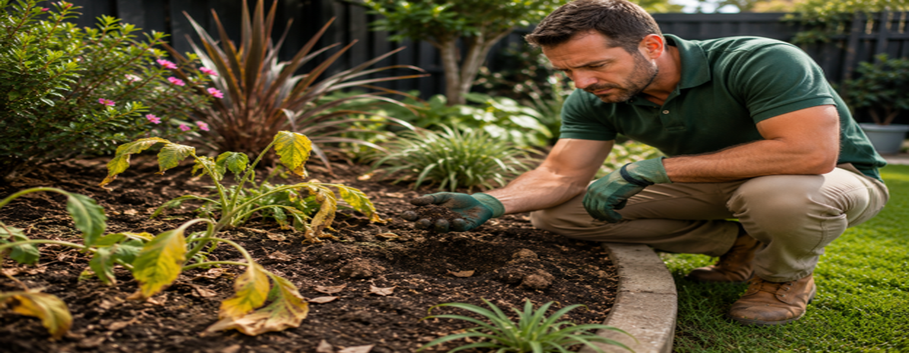
Healthy plants start below the surface. If your garden struggles despite regular watering and care, the soil is quite often the problem rather than the plants themselves.
You might notice:
- Plants that stop growing even during the growing season.
- Yellowing leaves despite consistent watering.
- Flowers and vegetables producing fewer blooms or smaller harvests than before.
- Soil that dries out too quickly or stays waterlogged after rain.
Bayside Gardening works with Melbourne gardens every day as a trusted provider of gardening services in Melbourne, diagnosing nutrient deficiencies, improving soil structure, and helping homeowners fix problems before they turn into expensive replacements. This guide covers the warning signs of unhealthy soil, why they appear, and what to do about them before the damage spreads.
Garden soil that lacks nutrients or has poor structure limits root growth, reduces flowering, increases disease pressure, and gradually weakens plants regardless of how often they are watered. Through professional gardening services in Melbourne, Bayside Gardening identifies soil problems early, helping property owners improve plant health through practical soil care, irrigation management, and seasonal maintenance rather than replacing plants that could have been saved.
Why Does Healthy Soil Matter More Than Most Gardeners Realise?
Soil is not just what plants sit in. It supplies nutrients, stores water, allows roots to breathe, and supports the microbial activity that keeps the whole system functioning. When that balance breaks down, plants show symptoms long before most homeowners suspect the soil.
Yellow leaves get blamed on not enough fertiliser. Slow growth gets blamed on the variety. Wilting gets blamed on heat. Quite often the soil is behind all of it, and adding more fertiliser to depleted or compacted ground does not change that.
Nutrient availability depends on soil pH, drainage, organic matter, and microbial activity working together. When any one of those is out of balance, plants may struggle to absorb nutrients even when fertiliser has already been applied. The fertiliser is there. The plant simply cannot access it.
One pattern that appears consistently across garden maintenance in Melbourne work is newly built homes with compacted construction soil beneath a thin layer of topsoil. Healthy plants fail in those conditions because their roots cannot spread far enough to support the growth above ground.
For gardens receiving regular professional support, soil health assessments are built into seasonal maintenance because catching problems early costs a fraction of what restoration requires later.
Bring Your Garden Back To Life
What Are The First Signs That Your Garden Soil Is Starving?
Plants send signals before they decline. Catching those signals early is what separates a simple soil correction from a full garden restoration.
| Warning Sign | What It Often Indicates | Why It Matters |
|---|---|---|
| Yellow leaves | Nutrient deficiency or poor nutrient uptake | Reduced photosynthesis slows growth |
| Slow growth | Compacted or nutrient-poor soil | Roots cannot access enough oxygen or nutrients |
| Poor flowering | Lack of phosphorus or potassium | Plants prioritise survival over producing blooms |
| Wilting after watering | Compacted soil or damaged roots | Water cannot move through the soil profile properly |
| Standing water | Poor drainage | Roots lose oxygen and become vulnerable to disease |
| Cracked dry soil | Low organic matter | Moisture escapes quickly during warmer weather |
Not every symptom points to one cause. Several conditions quite often appear together, which is why diagnosis based on leaf colour alone misses the real problem.
Poor drainage produces the same yellowing as nitrogen deficiency because saturated roots cannot absorb nutrients regardless of what is in the soil. Treating the symptom without understanding what is underneath it means the problem continues.
Could Your Watering Routine Be Making Soil Problems Worse?
Watering practices that do not match what the garden actually needs accelerate soil deterioration even in otherwise healthy ground.
Too much water removes oxygen from the root zone. Inconsistent watering causes repeated wetting and drying that weakens soil structure and reduces microbial activity over time. Both extremes damage the soil, just in different ways.
Properties with irrigation system installations help deliver moisture more evenly, but they still need seasonal adjustment. Irrigation schedules set for spring quite often become excessive during cooler months when evaporation rates drop and the soil stays moist for longer.
A common pattern in Melbourne gardens is water running off compacted soil rather than soaking in. Homeowners respond by watering for longer periods. The extra water still does not reach the root zone because the surface layer is preventing absorption. The problem is soil structure, not irrigation volume.
Garden irrigation specialists assess soil absorption rates alongside irrigation performance because both systems influence each other. Fixing the irrigation without addressing the compaction underneath does not solve the problem.
How Does Poor Soil Affect Different Types Of Plants?
Different plants respond to poor soil differently. None of them are immune to it. Native Australian plants tolerate lower fertility reasonably well but still need well-drained soil and functioning root zones. They fail more slowly than other plants, which quite often means the problem goes unnoticed longer.
Vegetable gardens feel the effects quickly. Crops grow fast and remove large amounts of nutrients from the soil each season. Without regular replenishment, productivity drops noticeably from one season to the next.
Flowering plants may keep producing leaves while dramatically cutting back on blooms. Homeowners quite often assume the variety is underperforming when the soil is the actual reason flowering has slowed.
Shrubs and established trees decline across several seasons rather than weeks. By the time the damage is visible, the underlying soil problem has usually been developing for a long time.
This gradual decline is why local maintenance programs catch problems that homeowners miss. Regular inspection identifies changes that accumulate slowly rather than waiting for visible decline to prompt action.
Mulch application is a practical example of where small decisions have consequences. Too much mulch pressed directly against tree trunks traps moisture at the base, encourages fungal growth, and restricts air movement around the root collar. Correct mulch placement improves soil without introducing a new problem.
Can Soil Be Restored Without Replacing Your Entire Garden?
In most cases, yes. Restoration takes time, but most unhealthy soils respond to consistent, targeted improvement without pulling everything out and starting again.
The focus should be on restoring the conditions that allow roots to function rather than simply increasing the nutrient load. Feeding a plant through soil that cannot support root activity does not produce lasting results.
Practical approaches that work include:
- Incorporating quality compost to rebuild soil structure and organic matter.
- Aerating compacted lawn and garden beds, similar to core aeration done during lawn mowing in Bayside to restore oxygen flow to root zones.
- Applying mulch correctly to regulate soil temperature and hold moisture longer.
- Improving drainage where water regularly pools after rain.
- Adjusting irrigation schedules to match actual seasonal conditions rather than fixed timers.
Where larger improvements are planned, pairing soil restoration with soft landscape design produces better long-term results. Planting layouts, irrigation, and soil preparation planned together from the beginning work with each other rather than against each other.
Scheduling professional garden cleanup services before soil improvement also matters. Excess debris, diseased material, and compacted organic waste left in place interfere with healthy soil recovery and quite often reintroduce the same problems the improvement is trying to fix.
Why Do Melbourne Gardens Develop Soil Problems More Often?
Melbourne’s weather pattern creates consistent pressure on garden soil. Long dry periods followed by heavy rainfall compact the soil, wash nutrients away, and reduce the microbial activity that keeps soil productive. Clay soils hold water too long. Sandy soils drain before roots can absorb what they need.
Repeated planting without restoring organic matter is another consistent contributor. Each growing season pulls nutrients out of the soil. Without replenishment, even well-established gardens gradually lose productivity.
Construction activity, heavy foot traffic, and regular lawn equipment compress soil and restrict root development in ways that are not always obvious until plants start showing stress.
One thing worth knowing is that different parts of the same garden can have completely different soil conditions. Areas under established trees, exposed lawn sections, and sheltered garden beds quite often need different management. A single treatment applied uniformly across the whole property rarely addresses what each area actually requires.
What Can You Do To Restore Soil Health Naturally?
Improving soil is gradual work. The goal is rebuilding structure rather than providing a temporary nutrient boost that fades within a season.
| Soil Problem | Practical Solution | Long Term Outcome |
|---|---|---|
| Compacted soil | Aerate garden beds and lawns | Better root growth and water penetration |
| Low organic matter | Add compost and quality mulch | Improved moisture retention and healthier soil biology |
| Poor drainage | Improve grading and soil structure | Reduced root disease and waterlogging |
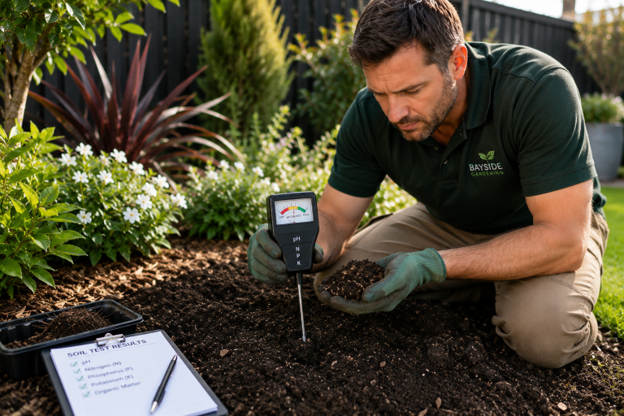
| Nutrient imbalance | Test soil before applying fertiliser | More accurate nutrient management |
| Rapid moisture loss | Maintain mulch depth throughout the year | More consistent soil moisture across seasons |
Adding excessive fertiliser to unhealthy soil quite often increases plant stress rather than relieving it. The nutrients cannot be absorbed efficiently when the soil structure preventing uptake has not been addressed first.
Timing matters too. Applying compost before a prolonged hot period does not deliver the same benefit as improving soil during cooler months when microbial activity and moisture levels support proper decomposition. The same material applied at the wrong time produces a fraction of the result.
How Can You Prevent Soil Problems Before They Start?
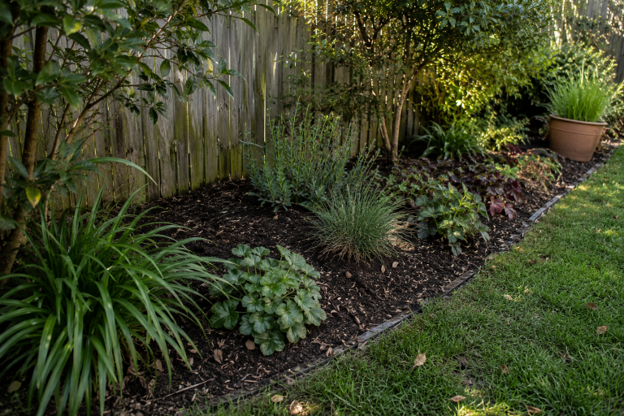
A consistent seasonal routine keeps soil productive throughout the year without requiring significant intervention.
| Season | Priority Tasks |
|---|---|
| Spring | Inspect new growth, top up mulch, check irrigation coverage across zones |
| Summer | Monitor soil moisture, adjust watering frequency, avoid heavy fertilising during heatwaves |
| Autumn | Add compost, remove diseased material, improve soil before winter rainfall begins |
| Winter | Check drainage, reduce compaction in high-traffic areas, prepare beds for spring planting |
Soil problems rarely develop overnight. Slower growth, reduced flowering, and slightly off-colour leaves appear months before plants decline seriously. Responding to those early signals is considerably cheaper than restoring a garden that has deteriorated significantly.
Restore Your Garden From The Ground Up
Conclusion
Healthy plants depend on healthy soil. When nutrients deplete, drainage declines, or structure breaks down, plants struggle regardless of how much they are watered or fertilised.
Catching those changes early is what keeps corrections straightforward rather than extensive.
With years of experience providing gardening services in Melbourne, Bayside Gardening helps homeowners identify soil problems, improve growing conditions, and maintain healthier outdoor spaces throughout the year. If your plants are showing signs of stress, a professional soil assessment gives you practical answers before replacement becomes the only option. Get in touch with our team to discuss the right approach for your garden.
FAQs
How often should garden soil be tested?
Every two to three years is a reasonable interval for most home gardens. Testing is also worth doing before major planting projects or when plants show ongoing signs of poor health despite regular care. It identifies nutrient deficiencies, pH problems, and drainage issues before unnecessary treatments get applied.
Can adding more fertiliser solve poor soil?
Not on its own. Fertiliser supplies nutrients but does not fix compaction, poor drainage, or depleted organic matter. Plants in structurally compromised soil may still be unable to absorb those nutrients regardless of how much fertiliser is added. Improving soil structure matters just as much.
Why do healthy-looking plants suddenly decline?
Plants quite often survive on stored nutrients before visible stress appears. Compaction, drainage problems, or declining soil biology can weaken roots gradually over months. By the time leaves change colour, the underlying problem has usually been developing for a long time.
Is mulch enough to improve soil?
Mulch regulates temperature, reduces moisture loss, and adds organic matter as it breaks down. It works best alongside compost, adjusted watering practices, and regular soil improvement rather than as a standalone fix for depleted or compacted ground.