
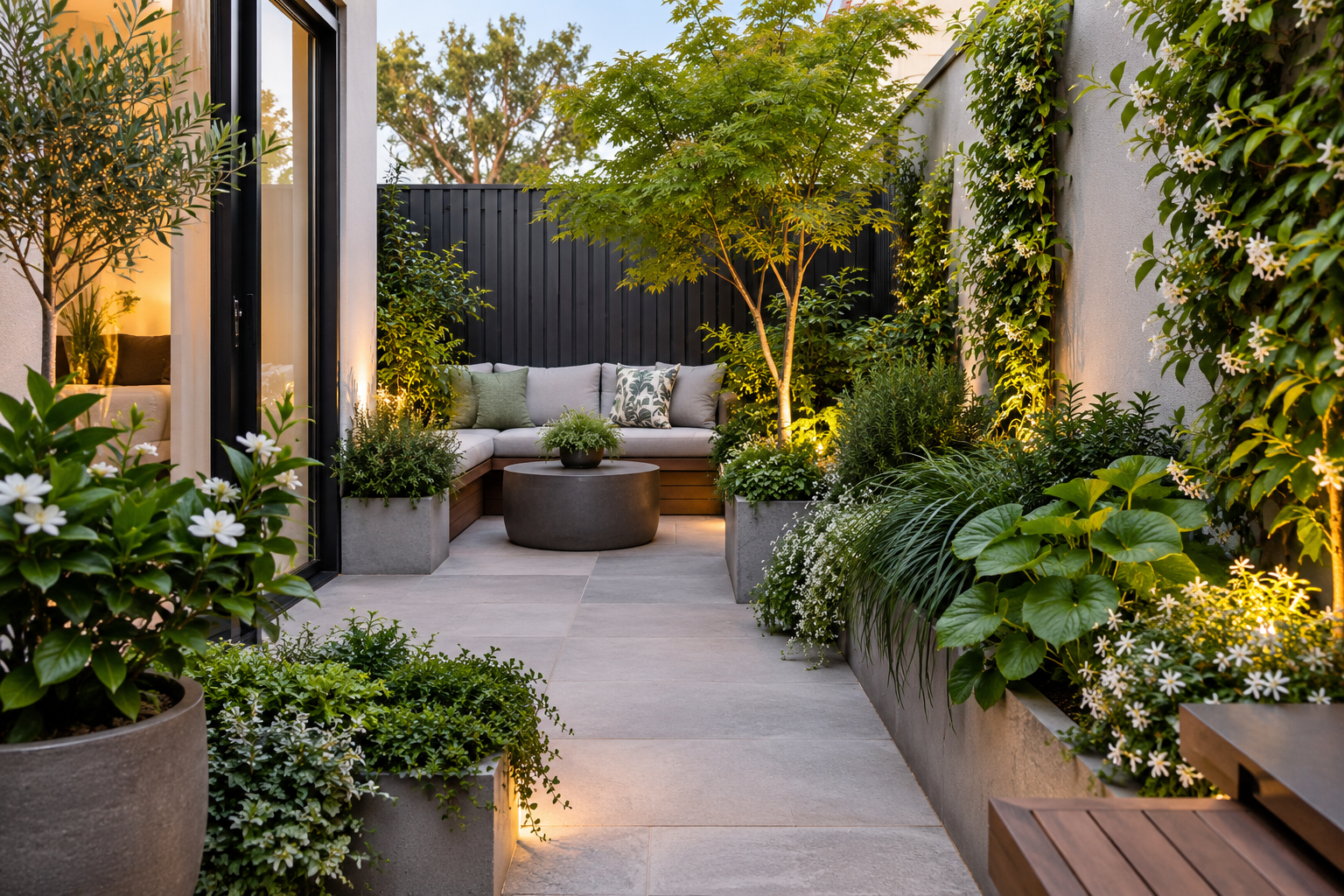
Small courtyards can feel cramped when every plant, pot and pathway competes for the same limited space. Poor plant selection can also create maintenance problems as plants mature.
A well-planned courtyard can still feel green, private and inviting when you:
- Choose plants according to sunlight and mature size.
- Choose vertical planting, but do not block natural light.
- Add plants of different heights to give depth.
- Keep practical watering points and access.
- Pick plants that will do well in Melbourne’s changing conditions.
At Bayside Gardening we have years of experience in horticulture and we know that with small outdoor spaces a little plant selection can go a long way rather than just adding more greenery. This article discusses practical ideas for soft landscape design in Melbourne courtyards.
Focus: Making compact courtyards feel greener without overcrowding the available space.
Key Considerations: Plant’s mature size, sunlight, drainage, privacy, access and seasonal changes.
Planting Approach: Soft landscaping combines trees, shrubs, climbers and ground covers at suitable scales.
Professional insight: Bayside Gardening bases planting combinations on plant growth habits and site conditions rather than just appearances.
Practical Outcome: The courtyard can be private, colourful and structured but still usable and manageable.
What Planting Ideas Can Make a Small Courtyard Look Bigger?
The best way is to create visual depth, but not fill all the available areas. Plant at different heights to draw the eye upwards and make a tight courtyard feel larger.
Use Three Planting Levels
A simple planting hierarchy works particularly well:
| Planting level | Suitable role | Examples |
|---|---|---|
| Upper level | Shade, structure or screening | Small ornamental trees |
| Middle level | Colour and structure | Shrubs and flowering plants |
| Lower level | Softening hard edges | Ground covers and compact perennials |
Keep Mature Size In Mind
A common mistake is choosing plants based on their size at installation.
A plant that fits comfortably beside a wall today may become difficult to manage after several growing seasons. Check its expected height and spread before planting, particularly beside fences, windows and narrow paths.
What most experts miss: In a small courtyard, the plant’s spread can matter just as much as its height. A plant with aggressive lateral growth can quickly reduce usable space even when its overall height remains manageable.
Create A Focal Point
One well-positioned feature plant can work better than several competing specimens.
Consider:
- A small multi-stemmed tree.
- A sculptural native plant.
- A flowering shrub.
- A feature planter positioned against a plain wall.
The focal point should have enough surrounding space to stand out. Crowding several feature plants together can make the courtyard feel smaller.
Create A Low-Maintenance Courtyard Garden
How Can You Add Privacy Without Losing Space?
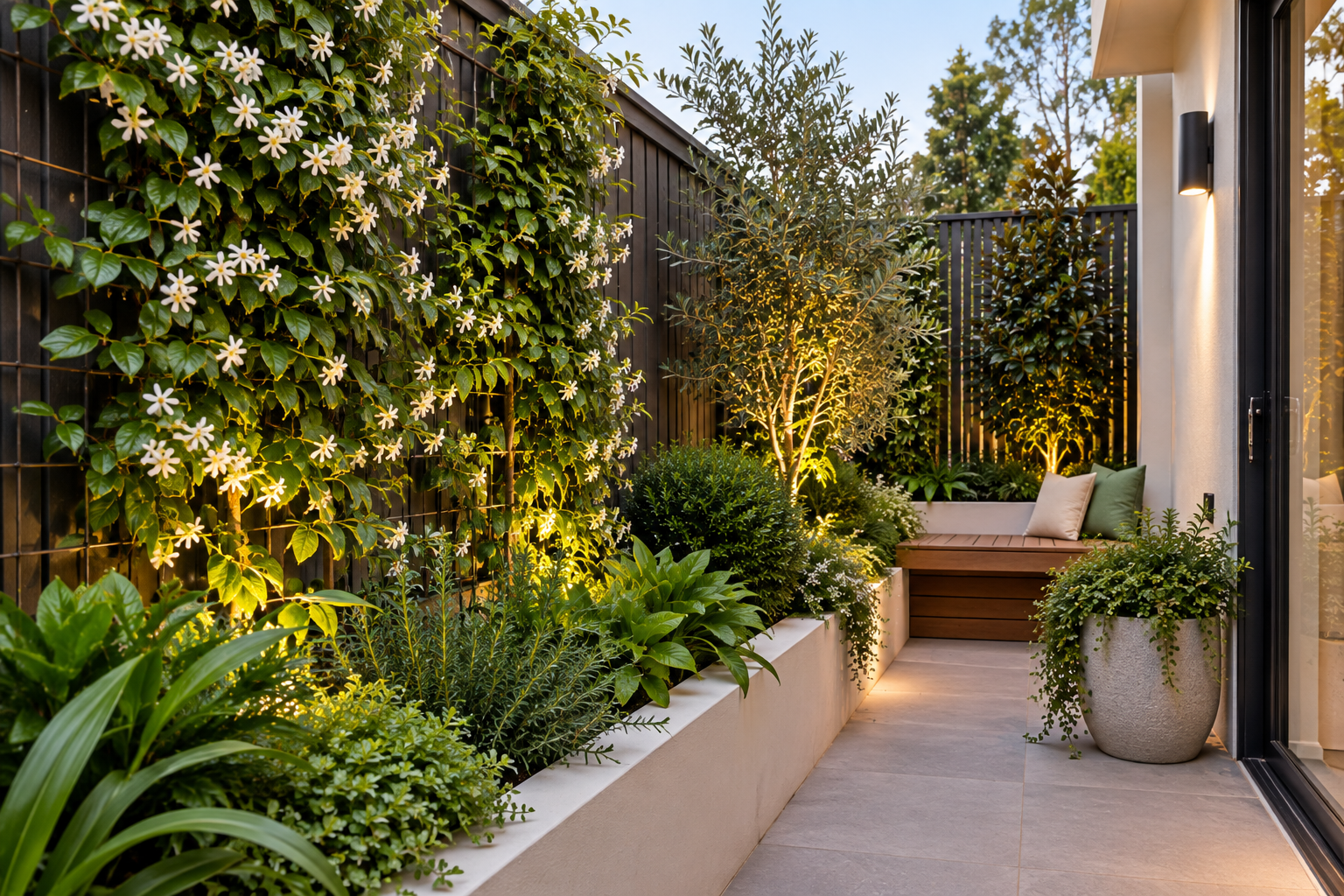
Privacy planting works best when it matches the height and width of the area that needs screening. Tall, narrow plants can provide separation without taking over valuable floor space.
Vertical Screening Options
Climbers can be particularly useful where horizontal planting space is limited.
Use Supports Carefully
A trellis or screening structure can support suitable climbers while keeping the planting footprint relatively small.
Before installation, consider:
- Available sunlight.
- Wall condition.
- Access for pruning.
- Mature plant weight.
- Irrigation requirements.
For a narrow courtyard, screening should protect privacy without turning the entire space into a dense green wall.
Choose Plants For The Specific View
You do not always need to screen an entire boundary.
If neighbouring windows are the main concern, targeted planting around the relevant sightline can reduce the amount of planting required. This leaves other areas open for light, ventilation and movement.
What most experts miss: Privacy planting should be planned from the viewpoint of the person using the courtyard. A screen positioned several metres away may block the wrong view while still leaving the most exposed window visible.
What Plants Suit Small Melbourne Courtyards?
Plant selection should start with the courtyard’s growing conditions. Melbourne properties can have very different microclimates depending on building orientation, surrounding walls, tree cover and reflected heat.
For Sunny Courtyards
Where the courtyard receives strong direct sunlight, consider plants that tolerate warmer and drier conditions.
Suitable choices may include:
- Westringia.
- Correa.
- Lomandra.
- Dianella.
- Compact grevilleas.
Always check the mature dimensions and specific growing requirements of the selected variety.
For Shaded Courtyards
Buildings and neighbouring structures can create heavily shaded spaces.
For these locations, consider shade-tolerant planting such as:
- Liriope.
- Clivia.
- Native violets.
- Certain ferns.
- Suitable shade-tolerant shrubs.
Watch For Reflected Heat
A courtyard surrounded by brick, concrete or rendered walls can become considerably warmer than an open garden.
This affects plant selection and watering requirements. Plants that tolerate ordinary shade may struggle when exposed to intense reflected afternoon heat.
How Can You Keep A Courtyard Green Without Creating More Maintenance?
Low-maintenance planting does not mean planting the same species everywhere. It means selecting plants whose growth habits match the available space and maintenance capacity.
Think Beyond Flowering Plants
A courtyard can retain visual interest through foliage, texture and form.
Try combining:
- Fine foliage: Adds movement and softness.
- Broad foliage: Creates contrast and visual weight.
- Architectural plants: Add structure in small spaces.
- Ground covers: Reduce exposed soil and soften hard edges.
This combination can provide interest even when individual plants are between flowering periods.
Keep Access In The Planting Plan
A courtyard still needs to function as a living space.
Leave practical access around:
- Doors and gates.
- Outdoor taps.
- Drainage points.
- Irrigation components.
- Air conditioning units.
- Utility areas.
Professional gardening services can help identify these practical constraints before planting becomes established.
What Should You Consider Before Starting A Courtyard Planting Project?
Before buying plants, assess the site itself. A short site assessment can prevent many problems later.
A Simple Courtyard Assessment
1. Measure The Space
Record planting bed dimensions, pathway widths and available vertical space.
2. Check Sunlight
Observe the courtyard at different times of day. Morning sun and afternoon sun can produce very different growing conditions.
3. Assess Drainage
Look for areas with standing water after rain or irrigation. Drainage can affect root health and plant selection.
4. Identify Existing Plants
Shade, competition from roots of existing trees and established shrubs and available moisture may already be impacting.
5. Irrigation Design
If irrigation points are considered before new planting, it is easier to water. Our garden irrigation specialists check the existing system for adequate coverage.
Can Soft Landscaping Work With Hard Courtyard Features?
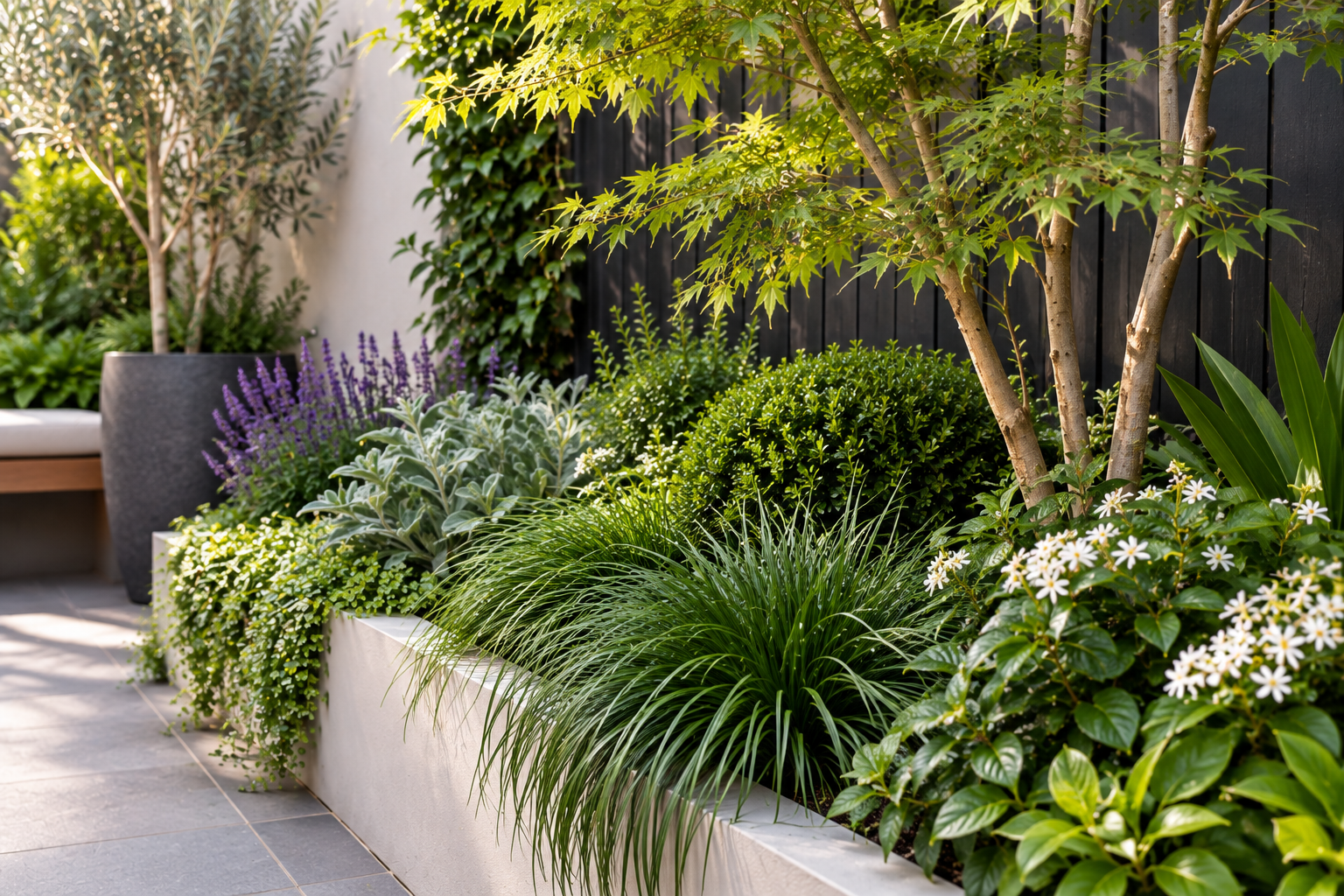
Yes. Plants work best when they complement the existing paving, walls, fencing, seating and other structural elements.
For example:
- Soften a rendered wall with climbers.
- Use ground covers beside paving.
- Place compact shrubs around seating areas.
- Use narrow planting beds along boundaries.
- Add foliage around otherwise plain entry points.
The aim is to balance greenery with usable space rather than cover every hard surface.
A Useful Design Rule
If the courtyard already contains strong visual elements, keep the planting simpler.
A patterned tile floor, feature wall or prominent outdoor furniture may already act as the focal point. In that situation, restrained planting can produce a cleaner result.
When Should You Get Professional Help With A Courtyard?
Professional input can be worthwhile when the courtyard has difficult shade, restricted access, drainage concerns or limited planting space.
Experienced horticultural professionals can assess:
- Plant suitability.
- Adult development.
- Soil and site conditions.
- Sunlight exposure.
- Water needs.
- Seasonal performance.
- Access for future maintenance.
Also, garden maintenance in Melbourne becomes less of a chore if the original planting plan has taken into account how fast each species grows and how much pruning it will need.
Choose Plants That Suit Your Courtyard
Conclusion
A small courtyard does not need a large plant collection to feel green and welcoming. Good soft landscape design comes from using the available space carefully, selecting plants for the actual growing conditions and leaving enough room for people to use the courtyard comfortably.
Bayside Gardening brings practical horticultural knowledge to residential planting projects across Melbourne. From plant selection to ongoing care, our team can help create a courtyard planting scheme that suits the space, the conditions and the level of maintenance you want to commit to.
FAQs
What is the best way to add greenery to a narrow courtyard?
Use vertical planting, compact shrubs and ground covers rather than filling the floor area with large plants. Climbers on suitable supports can add greenery while retaining walking and seating space.
Should I use native plants in a small courtyard?
Native plants can work very well, especially when you select species suited to the courtyard’s sunlight, soil and available space. Their suitability still depends on the individual species and cultivar, so mature size and growing conditions should be checked first.
How many plants should I put in a small courtyard?
There is no fixed number. Plant spacing should reflect mature plant size, available sunlight, access requirements and the desired visual effect. Overplanting at installation can create crowding as plants grow.
Can a shaded Melbourne courtyard still have colourful planting?
Yes . In deep shade flowering is usually more limited, but the colour, texture and form of the foliage can be of visual interest. Appropriate shade tolerant plants can be used that do not rely solely on flowers to provide a varied planting scheme.